

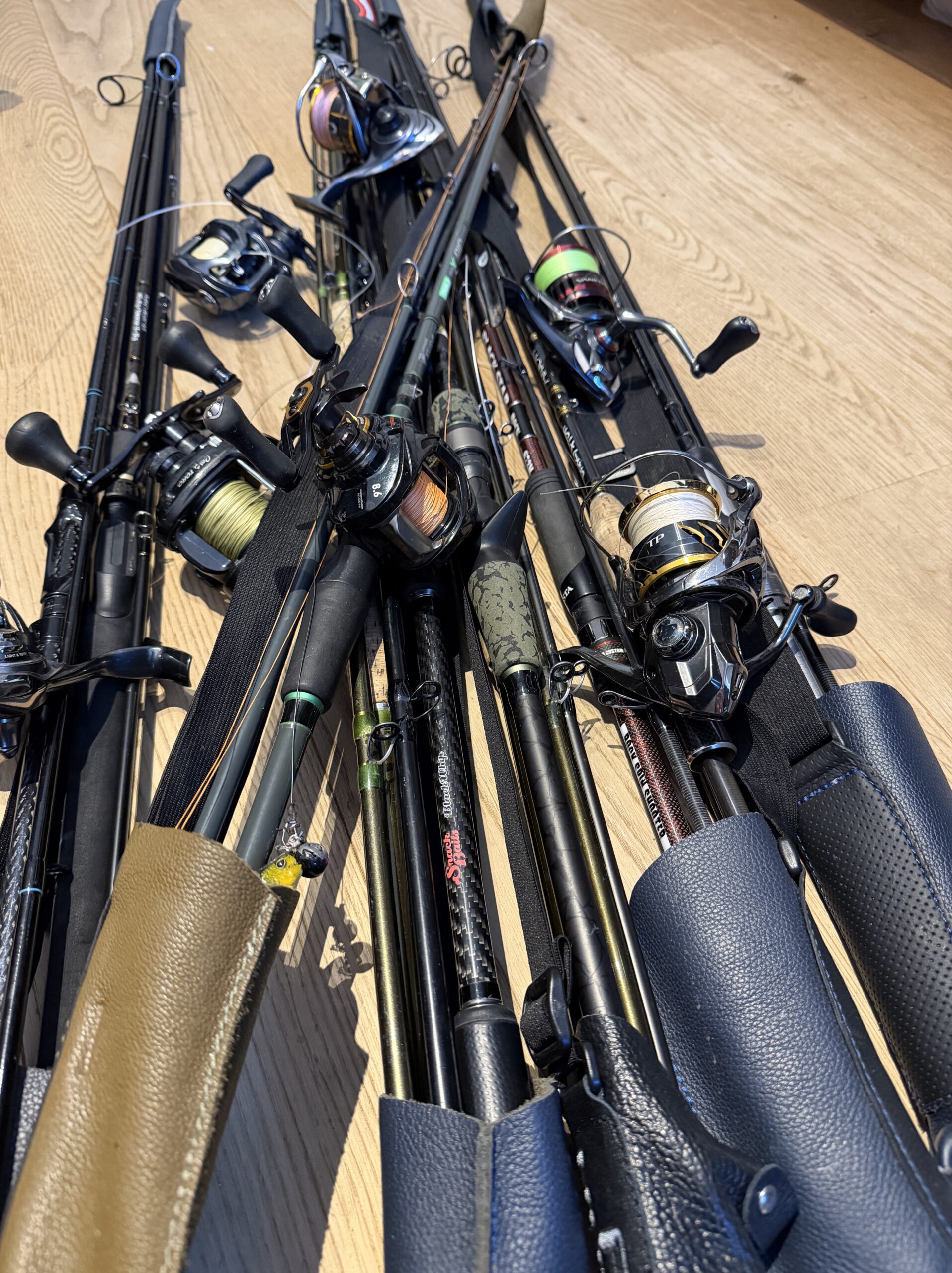
In both Rigafishing boats the gear is practically identical – the rods and reels we use as client setups are the same ones we use ourselves every day and in competitions. For every species, and even for every type of lure, you can put together a very specific, specialised rod‑and‑reel combo, but that’s not always necessary. There are plenty of versatile rods that work with a very wide range of lures and therefore let you target many different species. Below we’ll describe the rods and reels (setups) we use when fishing from the boat, and the gear we give to clients who come to learn, catch their fish and have a good time.
We’re definitely not claiming to have found the “ultimate truth”, and we fully realise this is not “perfect feng shui”. There’s more than enough theory out there about perfect setups for each technique, and you can always find some JP or US rod that’s “made” for a specific lure, a reel designed for a specific technique, and so on. This article is specifically about what we use, and briefly why we made these choices. Most of the rods are not top‑end flagship models, but mid‑range rods in the 150–250 EUR price segment.
If you’d like to learn, test some of these setups, have a great time and also catch your trophy fish with us – YOU CAN BOOK HERE.
Gear for pike fishing
Pike rods can be divided by the technique they’re intended for: twitching, jigging, spinners/chatterbaits, soft plastic shads, jerkbaits, BigBait, etc. Regardless of that, one of the most important factors when choosing a pike rod is its action. Pike have thin and relatively “fragile” lips: if the hook is set and the rod action is extra‑fast, fish are lost more often – classic “hook pulls”, because the hook can tear a large hole in the lip and when the pike shakes its head, the lure tends to fly out.
For pike we use a universal rod that works both with soft plastics and metal lures (spoons, chatters, spinners) and is also responsive enough for twitching.
In classic pike fishing we mostly choose rods in the 220–240 cm range. Of course, “on paper” twitching rods should be more like 190–210 cm, and for soft plastics you can go longer, 250–270 cm, etc. For us, versatile rods are more than enough, and we’ve found an excellent middle ground to work all the classic pike lures with good quality. By the way, all our “classic pike” setups are spooled with 4‑strand braid, because it’s more abrasion‑resistant when fishing in grass and reeds.
Choice
- Sportex Nova RS‑3 (PT2351) – casting weight 4–28 g, length 235 cm. The rod is crisp enough to twitch wobblers up to 130 mm, but soft enough to keep “hook pulls” relatively low. This rod is paired with a Shimano Twin Power 3000 reel and Sunline PE 1.5 4‑strand braid.
- Sportex Black Arrow G4 (146231) – casting weight 11–32 g, length 240 cm. For this range it feels very light and pleasant in the hand. It’s comfortable to cast both wobblers and soft baits. Just like the Nova RS, the Black Arrow is soft enough to “tie” the fish and prevent it shaking off the hook, yet crisp enough to work wobblers up to 130 mm comfortably. This rod is paired with a Daiwa Ballistic 4000 and Sunline PE 1.5 4‑strand braid.
- Sportex Nova RS‑3 (PT2442) – casting weight up to 53 g, length 240 cm. We mostly use this rod for casting soft plastics. With a 53 g upper limit you can comfortably cast baits up to 20 cm, and the rod handles that with ease. It’s paired with a Shimano Stradic 4000 and again Sunline PE 1.5 4‑strand braid.
- Xesta Black Star S73M – casting weight up to 28 g, length 222 cm. This rod is paired with a Daiwa Ballistic 4000LT; it’s light enough and has a nice crisp action for twitching and other lure types. Also spooled with PE 1.5 4‑strand braid.
BigBait setups for pike
We have several BigBait rods that work both for jerkbaits, larger swimbaits and soft plastics up to 28 cm. BigBait rods have come a long way over the years, and now there is a much wider selection than 7 years ago when we bought our first setups. That said, both rods and reels are still in good working order after 7 years of active use, and we still use them daily, both for classic fishing and pelagic casting for big pike.
Here, a rod length of 240–250 cm is the sweet spot: it’s reasonably comfortable both for casting rubber baits and “mice” style lures, and for working jerkbaits properly. If we were only fishing soft plastics, we’d choose 260–270 cm: with the extra length the rod’s leverage means you use less force on the cast, which in turn tires your body less over a full day of casting 100+ g lures. For pure jerkbait fishing we’d choose around 220 cm, because it’s easier to impart the desired action.
Choice
- BFT Roots 2 – Multipike – length 236 cm, casting weight up to 170 g. You can overload this rod a bit, and it casts Miuras Mouse, Giant Pig Shad, Shallow Buster jerkbaits very well. You can work any of these lures properly, and the rod has a good balance between stiffness and softness: it lets you work heavier, bigger jerkbaits, and at the same time it absorbs pike head shakes well, so there aren’t many hook pulls. The reel on this rod is the previous‑generation Abu Garcia Revo Toro Beast, arguably one of the strongest, most “un‑killable” reels out there. The line is StrikeWire braid, 0.36 mm diameter.
- SnackBaits Black Whip – casting weight up to 120 g, length 241 cm. This rod is more enjoyable to fish with, and playing 2–3 kg pike on it is much more fun. That’s naturally because it’s lighter and the test is lower, which means the realistic max lure weight is around 100 g (once you add stingers, lead, etc. you’re at the 120 g mark) – roughly for 23–24 cm soft lures. The rod is softer and jerkbaits are a bit harder to work with it. So I’d say this rod is very pleasant specifically when fighting fish and works great with swimbaits and soft plastics; for jerkbaits you’d want something sharper. This setup is paired with an Abu Garcia Revo Beast X and 0.32 mm braid.
Gear for perch fishing
Perch rods can be very different, and many people choose a rod primarily for the technique they use most. We fish for perch with wobblers and hard baits (spinners, chatterbaits) about 80% of the time, so our rods are tuned to those techniques. That said, these rods can also be used for jigging quite effectively. The only note is that for jig or micro‑jig, the ideal casting weights would probably be lower.
Choice
- Crazy Fish Arion ASR832LS – casting weight 3–15 g, length 252 cm. This rod has excellent casting performance – lures fly very far with little effort. We mainly use it for jig, drop‑shot or atvadas (side‑leader) rigs. It’s sensitive enough to feel every contact with the bottom. Paired with a Shimano Vanford 3000 and Sunline PE 0.6 8‑strand braid.
- Crazy Fish Arion ASR762LS – casting weight 3–12 g, length 229 cm. This rod is excellent for wobblers and other hard baits. Because it’s relatively short, it’s easy to cast accurately, control the lure, and every perch tap on the lure is clearly felt in the hand. Thanks to the light weight and high‑grade carbon, fighting fish is very enjoyable. It’s paired with a Shimano Twin Power 2500 with 0.8 PE 8‑strand braid. Here the braid is slightly thicker because we mostly cast wobblers and chatterbaits, where snags are more likely. If you use it for jigging or other “bottom” techniques, we’d recommend a thinner diameter braid for better sensitivity.
- Ir arī pāris microjig kāti, bet no tiem nav īsti ko izcelt. Microjig kā tādu izmantojam reti un lielākoties tur pietiek ar augstāk minētajiem arion modeļiem.
Gear for pelagic fishing with Live technologies and zander
For pelagic fishing we use universal rods with a fairly wide casting range. Lure size is from 4″ up to 10″, with the average “working” size around 6–7″ soft baits. Depending on the water body, season and target species, the weight of the jig head/sinker changes from 5 g up to 50+ g, especially when fishing in current and deep water where you need to get the lure down as quickly as possible.
From our experience, the ideal rod length is 205–230 cm. With a shorter rod it’s harder to set the hook properly and hook pulls happen more often; it’s also harder to lift the lure quickly enough not to snag the electric motor if the boat turns. A rod longer than 230 cm becomes a bit uncomfortable for lure control, and you can’t work the lure right up close to the boat (transducer) if a fish is following. So the golden middle is between 205 and 230 cm.
Choice
- Sportex Jig X‑pert 159224 – casting weight 28–85 g, length 225 cm. An outstanding universal rod: it might feel a bit “clubby”, but it’s sensitive enough to feel bites from fish that only nudge the lure or tap it from below. It’s soft enough, and the action responds well to fish runs, reducing the number of hook pulls because the rod works even on smaller fish. It handles big fish brilliantly, and with these setups we’ve landed many trophy pike over 100 cm and zander over 80 cm. We also use this rod for catfish; our largest ones at 190 cm, 156 cm and 136 cm were caught on this rod. Of course, on smaller fish (40–60 cm) the “thrill” is a bit less, but with one rod you cover a huge range: from casting a 4″ lure with a 10 g weight to, slightly overloading it on short casts, a 110 g soft bait with a 20 g weight – if you cast carefully, it handles those weights too.
- Nays NXT – casting weight 7–28 g, length 215 cm. We use this rod specifically for smaller fish – mainly sea zander. Fish in the 45–60 cm range already put up enough resistance to make the fight fun. This rod is crisper, with a fast action compared to the Jig X‑pert, which is necessary because the casting weight is lower but zander have very hard, bony mouths – at short distance you need a very sharp hook set to drive the hook through the bone.
- As for reels in pelagic fishing, we only use baitcasting (multiplier) reels. We personally like Daiwa baitcasters. On these rods we run Daiwa Zillion and Daiwa Morethan PE. We’ve also used Daiwa Tatula, Shimano Curado DC and other Shimano reels.
Very briefly, based on our personal experience: Daiwa baitcasters cast better and easier, feel nice in use and have a great‑sounding drag, but they are “weaker” mechanically and need servicing every season because something inside the reel starts to make noise. Shimano reels, on the other hand, are more durable but don’t cast as well.
Of course, in each boat you’ll find several other setups, but those are more like backup options. In this article we’ve described the gear we truly use on a daily basis.
If you’ve read this far – thank you; we’ll really appreciate it if you share your own experience or leave a comment. And if you’ve decided to buy one of the Sportex Jig X‑pert rods for the new season, you can get a 15% discount on this rod series at www.NGT.lv with the code “RigaFishing”. I should also mention that these rods are not only great for pelagic fishing, but also for classic pike and zander fishing.


