

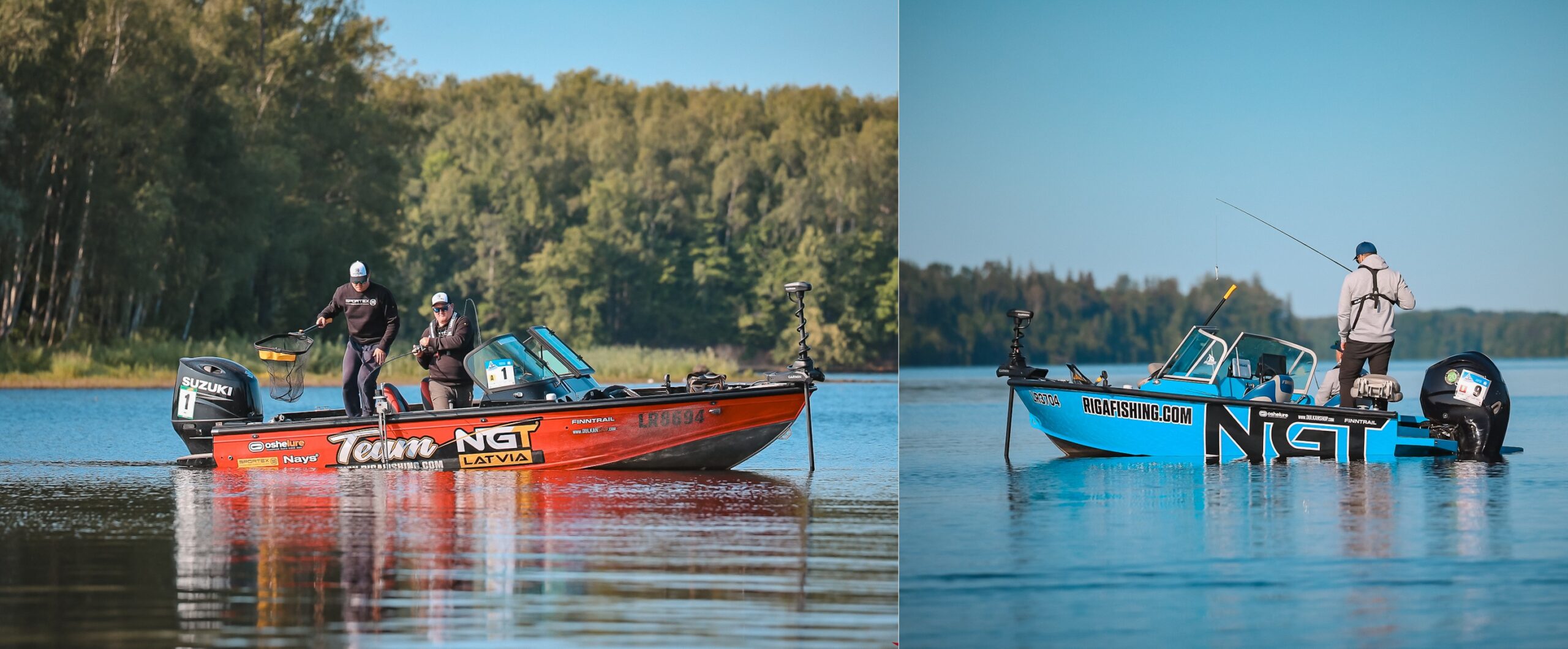
Rigafishing has two boats. The hulls and main engines are different, but the setup and electronics are about 90% identical. We’ve arrived at what we consider the best possible setup in terms of fishing electronics. We’ll split this post into several sections: a very short overview of the hulls and engines and their pros, a separate section and explanation on the trolling motor and how to choose it, a section on fishfinders and transducers, and a separate part on the boat layout/outfitting with lights, batteries, gadgets (rotators, etc.). At the end we’ll also include practical information on where to buy everything and where to take your boat for installation.
A note, just like in the previous post about gear (rods). This is our personal experience after testing many different screens, batteries, rotators, etc. on our own boats, as well as while guiding and training other anglers on their boats. In this post we describe the equipment we consider the best and what we personally find most comfortable to fish with – both “classic” and with Live technologies.
Fishing boat and marshall engine
Gatis’s boat hull is a NorthSilver 585, with a hull length of 585 cm and width of 221 cm. The boat has excellent running characteristics and you can run “full throttle” in waves. The hull isn’t the absolute fastest, but it’s the best middle ground – fast enough, cuts through waves very well and doesn’t roll from side to side while fishing. We’ve ridden in a lot of different boats, each with its pros and cons; Gatis’s boat hits that sweet spot between speed and comfort. The boat is powered by a Suzuki 175 hp outboard and the maximum speed in normal mode with 3 people on board is 74 km/h. It has managed 78 km/h once with one person and going with the current, but those are exceptions. The trailer is a twin‑axle Respo.
om’s hull is a Palmer 500, with a length of 498 cm and width of 196 cm. The boat is not a true deep‑V, but it handles well; in bigger waves it “hits” a bit more. It’s powered by a Tohatsu 115 hp outboard and the maximum speed is about 68–70 km/h. The trailer is also Respo. This boat is also comfortable for both competitions and guiding 1–2 people, because it doesn’t roll too much and is big enough that you don’t get in each other’s way while fishing.
From our experience, Suzuki and Tohatsu engines have very good support in Latvia – both warranty and post‑warranty service. Both Vimmo and Boatshop are very friendly to boat owners.
Choosing a trolling motor (iPilot‑type)
When it comes to trolling motors, we’ve had all the most popular models on our boats that are available on the market. The only ones we haven’t personally tested on our boat are Haswing and Watersnake, but based on available information we don’t consider them directly comparable to Garmin, Minn Kota or Lowrance.
Because MotorGuide has left the market, for smaller boats with 12 V systems the only real option that remains is Minn Kota. Regardless of that, in the 12 V segment Minn Kota is the leader anyway and, in our view, makes the best motors if you compare them to MotorGuide, Haswing or Watersnake.
For larger boats with 24 V or 36 V systems the competition is stronger – Garmin, Lowrance and Minn Kota: three big brands competing with each other. I personally had a Lowrance Ghost on my boat for a short time. It’s not a bad trolling motor, but the downsides are the pedal – it’s wired and there’s no wireless option. A friend had a Lowrance (Recon) on his boat; in less than a month, after giving the motor a bit of load and a small “bump”, it completely stopped working. Lowrance trolling motors also hold anchor/spot‑lock worse than Minn Kota and Garmin.
Talking about Minn Kota – the newer models are very good, but they can “glitch”: my remote would occasionally switch off without reason, and for a well‑known local angler the motor sometimes loses connection to the fishfinder and you lose control, etc. Aside from that, overall the motors are reasonably high‑quality and durable, and the GPS is quite good. Feature‑wise, especially if you run a Humminbird fishfinder, there are some very impressive bonuses like Drift mode and following depth contours on the chart. The main cons – a less comfortable foot pedal, and the black Minn Kota versions in Riga waters (or closer to brackish water) tend to rust and seize up after just one season.
And then there are Garmin trolling motors – in our experience, the best and most durable motors, plus with excellent after‑sales and warranty service (which we’ve only needed once). On both boats we run Garmin Force Kraken trolling motors, both on 24 V systems with 100 Ah batteries. The only difference: on the Palmer the shaft is 63″, and on Gatis’s NorthSilver it’s 75″.
We choose Garmin because their motors are robust and stiff – if you run into shallows and “sit” on something or bump a submerged rock, the motor will not be damaged easily; the construction is much stronger compared to other brands. The second clear advantage is the wireless foot pedal, which works like a joystick – you don’t even need to look at the motor; just by the pedal orientation (centre, up, down) you know which way the motor is pointing. This helps a lot to “spin” and control the boat comfortably, quickly and effectively when fishing with Live technologies.
And of course, there’s the bonus when all electronics are on the same network – in our case with Garmin fishfinders. You can set routes from the chart, control trolling motor parameters and more. In terms of GPS and holding on anchor: if the motor is calibrated properly, Garmin trolling motors are, in our opinion, the leaders for spot‑lock (not counting the very first Garmin Force version from 5 years ago, which is no longer made).
With our 24 V system, both boats run at about 5.5 km/h on the trolling motor alone in moderate wind. I know a fibreglass Astra 470 hull with the same system does 7–8 km/h at max power.
Fishfinders – side, down, Live and charts
We’ve had all the major brands of fishfinders on our own boats, and on client boats we’ve used and tuned practically all the top screen models and transducers. We’ll go through side imaging, down view and charts, and then separately compare the Live transducers.
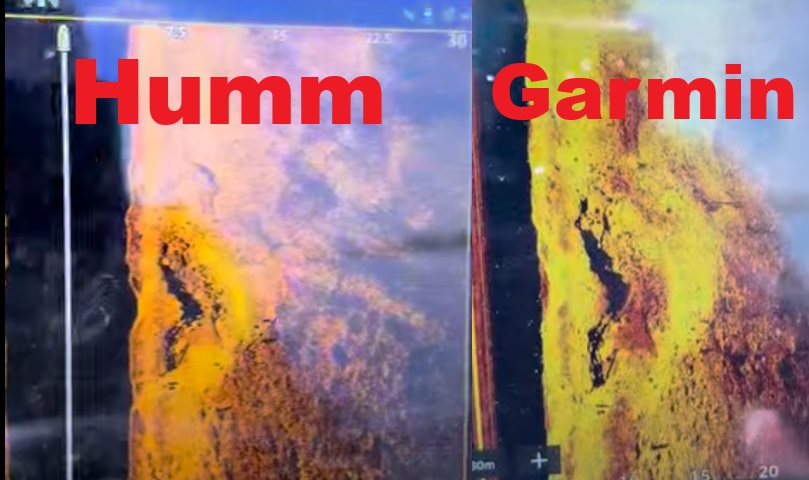
Side Imaging – In essence, for all three brands, the top models with the latest transducers have very similar side imaging quality – Humminbird Solix, Apex and Xplore, Lowrance HDS Pro with the new ActiveImaging 3‑in‑1 transducer, and Garmin with the GT‑56 transducer. I even made a comparison image from my own boat with Humminbird and Garmin on the same screenshot. Although Humminbird still looks about 10% “better” and prettier, for us that wouldn’t be the deciding factor when choosing a fishfinder.
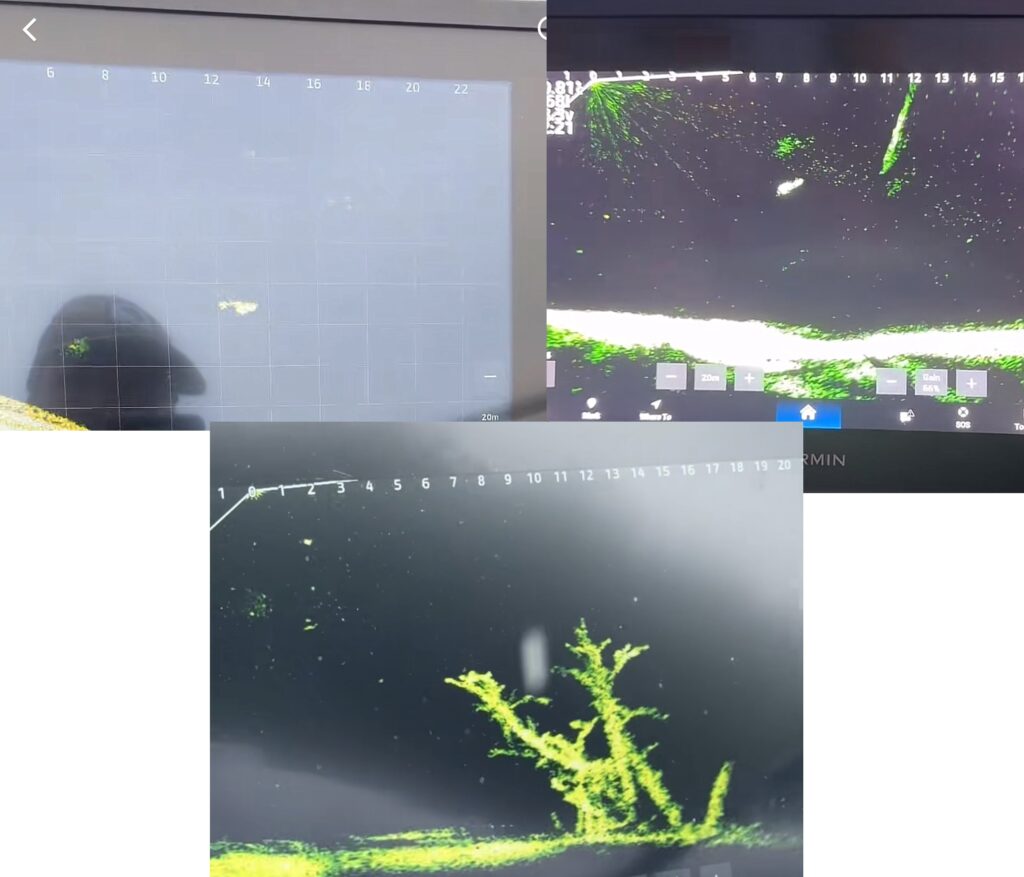
Down view – Since Live technologies became available, we use down view very rarely – basically only in competitions where only “classic” sonar is allowed – because with a Live transducer you can see everything much better and more clearly. But if I have to compare, then from experience Humminbird’s down view seems a bit worse than Lowrance and Garmin.
Charts – The most convenient interface and icons, in our opinion, are on Lowrance units – it’s easiest to navigate the menus, set up clear icons, etc. Garmin and Humminbird charts have similar functionality and a similar user interface/experience. I definitely wouldn’t call them bad; it’s just that Lowrance feels slightly more intuitive to the user, Garmin is nicely customisable and Humminbird is a bit more complex.
Humminbird MegaLive2, Garmin Panoptix Livescope LVS34, Lowrance ActiveTarget2 and AT2 XL
We’ve fished with all of the above Live transducers, except for ActiveTarget 2 XL. In our view, Humminbird MegaLive2 is the weakest transducer of the three brands. It’s harder to understand the exact shape of the fish; it’s somewhat distorted, and at longer range the beam accuracy is also lost. The only real plus of the Humminbird transducer is that it’s built differently from Lowrance and Garmin and the beam doesn’t have a glued joint where inaccuracies often appear.
The Lowrance AT2 beam is narrower than on Humminbird and Garmin, which means the fish shape is clearly readable up to about 12 m. At 12–14+ m Lowrance mostly shows a larger “blob” that you should pay attention to; to understand exactly what fish it is, you need to move closer. Even so, the glued areas on the Lowrance AT2 are quite well done, and at longer distances it does still show the fish, maybe with less perfect shape.
The biggest plus of Lowrance is that you plug it in, switch it on – and it just works. There are only 2–3 settings you adjust slightly and that’s it. In that sense Lowrance is very user‑friendly, and even for a beginner the Live image will look good. The minus of Lowrance Live is that there’s a small micro‑delay: what you see on the screen is about 0.25–0.5 seconds behind real time. You can get used to it, but sometimes it is annoying.
We don’t yet have personal experience with AT2 XL, but from studying the specs and watching the available videos on Facebook and YouTube, the beam appears slightly wider, more like the Garmin LVS34, which means the image and fish shape are easier to see at longer distances as well. In short – AT2 XL is very similar to the Garmin LVS34 transducer.
The Garmin Panoptix Livescope (LVS34) transducer, in our opinion, is the best Live option. The fish shape is the easiest to read, even at longer distances of 20–25 m, there is no delay and the picture is relatively clean. On the minus side, depending on how you “get lucky” with your particular unit, the glued areas in the beam can be more noticeable on some transducers and nearly perfect on others.
The second thing – Garmin is not fully “user‑friendly”: the auto settings definitely don’t give you the best possible picture, and there are more than 7 parameters you have to tweak to get an optimal image. But once that’s done, the picture is close to perfect.
If you want to tune your Garmin Live transducer and set it up properly, or adjust and get advice on any other brand of fishfinder or trolling motor – you can book a session with us for on‑the‑water training and setup in your boat.
Short summary of our fishfinder setup – Up to now, both boats had:
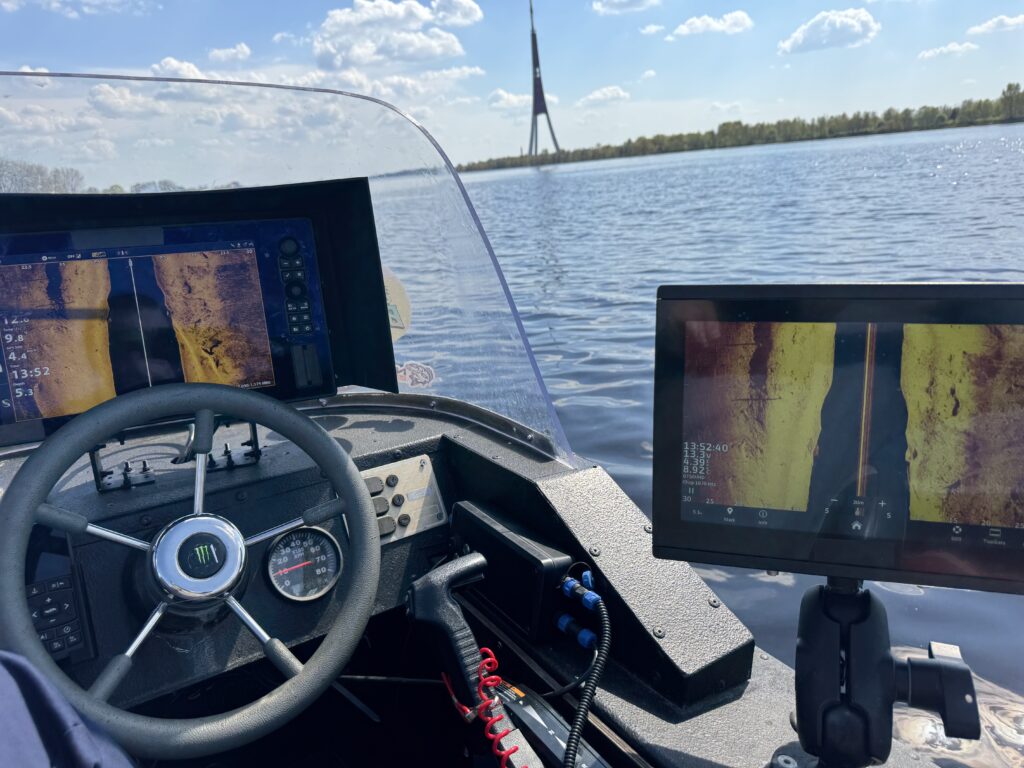
Lowrance Elite 9FS as the chart unit, Garmin GPSMAP 8412xsv for Panoptix, Live and side imaging, and GPSMAP 1223xsv at the bow so that when fishing “classic” style, you see the chart, side and down imaging.
We choose the GPSMAP models because they have better resolution, more powerful processors and overall better performance compared to the Garmin Echomap Ultra series. 2026. For the 2026 season we’re switching to a full‑Garmin setup. For the map we chose a Garmin GPSMAP 923xsv connected to the trolling motor, so at any moment you can see the chart, trolling motor speed, anchor/spot‑lock controls and other functions in just a couple of taps.
For Live at the console we replaced the unit with the newest GPSMAP series – 9013xsv, and in the bow we installed 8412xsv, connected to the GT‑56 transducer built into the bow trolling motor. We switched to the 9013xsv because of the Ultra HD resolution, which makes the image “cleaner” in Live and other views, plus the increased processing speed.
Boat lighting, batteries, rotators and other handy things
Everyone ends up with their own set of small tweaks and quirks, but here we’ll describe what’s installed on each of our boats and what, in our opinion, makes life easier. We’ll also mention some of the best gadgets not yet covered above that improve day‑to‑day or competition fishing and overall comfort on the boat.
Rotators – We use and definitely recommend “Jaņķelis” rotators – in our opinion they have the best software; there’s even a built‑in gyroscope that, with a button press, keeps the beam pointed at the same spot while the boat rotates. There’s both manual and electronic rotation, plus lots of additional adjustments. This is, without exaggeration, the best rotator on the market – I’d even say one of the best in the world.
Batteries – For both the 24 V trolling motor system and the 12 V system for fishfinders, boat lighting, music and other consumers, we use HyperionCell batteries, built in Latvia by Ģirts Kehris. On both boats we run a 24 V 100 Ah battery for the trolling motor and a 12 V 100 Ah battery for the rest of the electronics. HyperionCell has caused no issues for us or other users over several years and is definitely at the top end in terms of quality. After three years of use, measured capacity loss was only 2–3%, which is negligible. We can confidently recommend these batteries.
Music -Gatis has a Garmin Fusion system installed, and Tom runs a cheaper Goldenship setup. We actually listen to music on the fishing boats quite rarely, so before you install audio, think carefully about how often you’ll realistically use it and what level of system you really need.
Lighting –
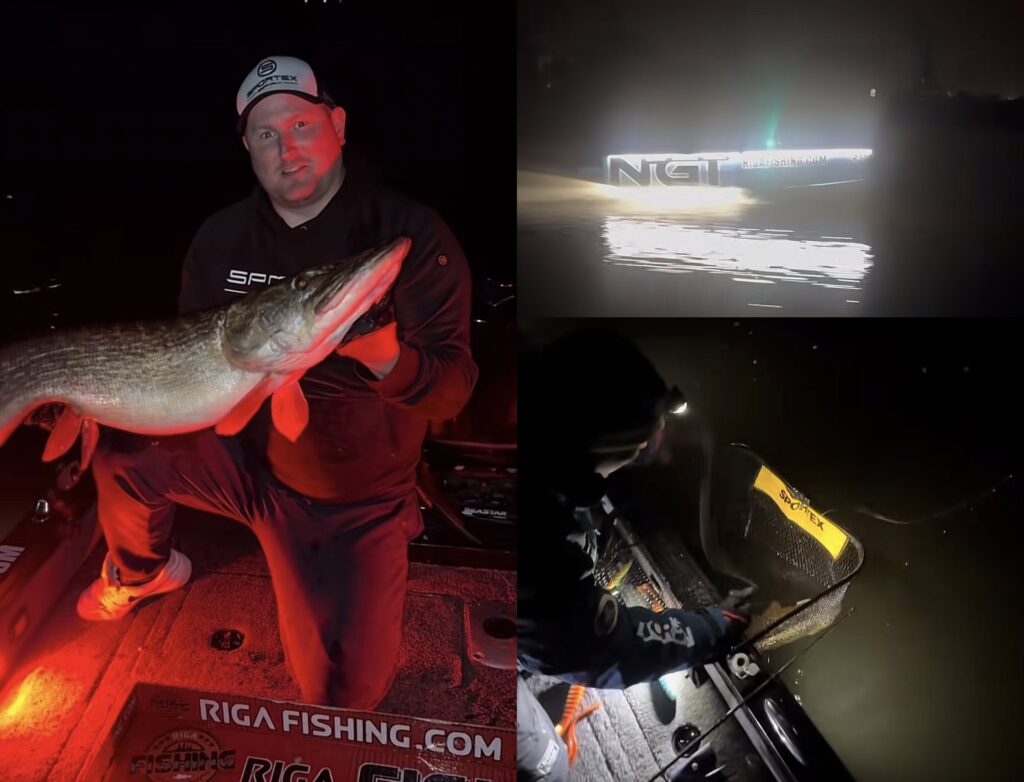
Along the outside of the NorthSilver hull we’ve installed individual lights; on the Palmer we have an external LED strip. If you like fishing at night, these lights not only look cool while driving, but, when switched on, help you net the fish because they illuminate the side of the boat and the water very well.
Inside the boat we also recommend installing either lights or LED strips so you can turn them on at night when you need to change a lure, retie or just tidy up the boat. Lighting outside and inside is very important for night fishing, and you’ll definitely appreciate it once it’s installed – you really can’t have “too much” light here. Just keep in mind that LED strips are more power‑hungry, and if you put several meters of LED both outside and inside, a 100 Ah 12 V battery might not be enough to power them all night long.
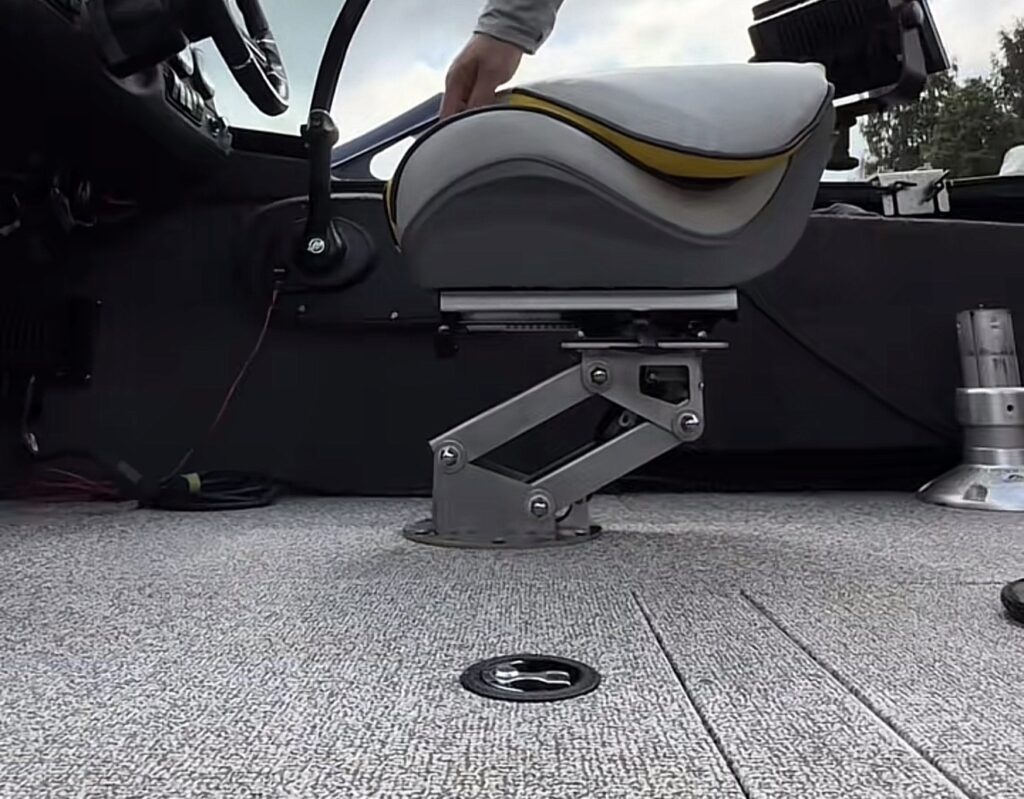
It’s very advisable to fit the boat with suspension seats. This is not only about comfort, but also about health. If you drive through big waves at high speed on a standard fixed seat, evening back pain is almost guaranteed. Long‑term, that can lead to more serious issues, but a seat with a shock absorber largely prevents this.
For boats that run 40+ km/h, we would definitely recommend installing suspension bases so you don’t end up visiting a trauma doctor after a windy‑day session. Suspension gives comfort and protects your health; we believe suspension seats should really come as standard, because otherwise fast driving can literally be painful. These suspension bases are also made by Jaņķelis.
We recommend buying boat electronics from www.Dulkanshop.lv – prices are among the best in Latvia, and communication and warranty service are top‑level. So far we’ve only had positive experiences working with Dulkan.
We do boat rigging (installation) with www.lazergriezana.lv – they also manufacture and sell the rotators and seat suspension bases we mentioned above.
If you’d like to upgrade your boat’s electronics, change the layout or otherwise improve comfort on board, we can help with recommendations or a detailed consultation. Feel free to write in the comments under the Facebook post, in Messenger, or via WhatsApp – our contacts are available Here.


